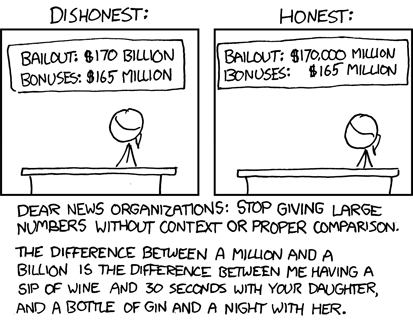
So I've been holding this notion that everything in this blog should be thoroughly considered, if not researched, before I post it. This is likely the result of 4 years of writing under pretty strict academic standards, and it's exhausting. It also keeps me from writing. So I'm giving that up in favor of knee-jerk reactions and sometimes amateurish opinions - it's actually much more fun.
Anyway, in the past couple of days I've come across some interesting perspectives on the whole AIG thing. The first, copied above, is an XKCD comic. (Side note - this comic is awesome). The second is a resignation letter published in the Times Opinion column today. I don't think I have much to add to it, but it would be cool to have a discussion in the comments section if you have any thoughts.
Dear A.I.G., I Quit!
The following is a letter sent on Tuesday by Jake DeSantis, an executive vice president of the American International Group’s financial products unit, to Edward M. Liddy, the chief executive of A.I.G.
DEAR Mr. Liddy,
It is with deep regret that I submit my notice of resignation from A.I.G. Financial Products. I hope you take the time to read this entire letter. Before describing the details of my decision, I want to offer some context:
I am proud of everything I have done for the commodity and equity divisions of A.I.G.-F.P. I was in no way involved in — or responsible for — the credit default swap transactions that have hamstrung A.I.G. Nor were more than a handful of the 400 current employees of A.I.G.-F.P. Most of those responsible have left the company and have conspicuously escaped the public outrage.
After 12 months of hard work dismantling the company — during which A.I.G. reassured us many times we would be rewarded in March 2009 — we in the financial products unit have been betrayed by A.I.G. and are being unfairly persecuted by elected officials. In response to this, I will now leave the company and donate my entire post-tax retention payment to those suffering from the global economic downturn. My intent is to keep none of the money myself.
I take this action after 11 years of dedicated, honorable service to A.I.G. I can no longer effectively perform my duties in this dysfunctional environment, nor am I being paid to do so. Like you, I was asked to work for an annual salary of $1, and I agreed out of a sense of duty to the company and to the public officials who have come to its aid. Having now been let down by both, I can no longer justify spending 10, 12, 14 hours a day away from my family for the benefit of those who have let me down.
You and I have never met or spoken to each other, so I’d like to tell you about myself. I was raised by schoolteachers working multiple jobs in a world of closing steel mills. My hard work earned me acceptance to M.I.T., and the institute’s generous financial aid enabled me to attend. I had fulfilled my American dream.
I started at this company in 1998 as an equity trader, became the head of equity and commodity trading and, a couple of years before A.I.G.’s meltdown last September, was named the head of business development for commodities. Over this period the equity and commodity units were consistently profitable — in most years generating net profits of well over $100 million. Most recently, during the dismantling of A.I.G.-F.P., I was an integral player in the pending sale of its well-regarded commodity index business to UBS. As you know, business unit sales like this are crucial to A.I.G.’s effort to repay the American taxpayer.
The profitability of the businesses with which I was associated clearly supported my compensation. I never received any pay resulting from the credit default swaps that are now losing so much money. I did, however, like many others here, lose a significant portion of my life savings in the form of deferred compensation invested in the capital of A.I.G.-F.P. because of those losses. In this way I have personally suffered from this controversial activity — directly as well as indirectly with the rest of the taxpayers.
I have the utmost respect for the civic duty that you are now performing at A.I.G. You are as blameless for these credit default swap losses as I am. You answered your country’s call and you are taking a tremendous beating for it.
But you also are aware that most of the employees of your financial products unit had nothing to do with the large losses. And I am disappointed and frustrated over your lack of support for us. I and many others in the unit feel betrayed that you failed to stand up for us in the face of untrue and unfair accusations from certain members of Congress last Wednesday and from the press over our retention payments, and that you didn’t defend us against the baseless and reckless comments made by the attorneys general of New York and Connecticut.
My guess is that in October, when you learned of these retention contracts, you realized that the employees of the financial products unit needed some incentive to stay and that the contracts, being both ethical and useful, should be left to stand. That’s probably why A.I.G. management assured us on three occasions during that month that the company would “live up to its commitment” to honor the contract guarantees.
That may be why you decided to accelerate by three months more than a quarter of the amounts due under the contracts. That action signified to us your support, and was hardly something that one would do if he truly found the contracts “distasteful.”
That may also be why you authorized the balance of the payments on March 13.
At no time during the past six months that you have been leading A.I.G. did you ask us to revise, renegotiate or break these contracts — until several hours before your appearance last week before Congress.
I think your initial decision to honor the contracts was both ethical and financially astute, but it seems to have been politically unwise. It’s now apparent that you either misunderstood the agreements that you had made — tacit or otherwise — with the Federal Reserve, the Treasury, various members of Congress and Attorney General Andrew Cuomo of New York, or were not strong enough to withstand the shifting political winds.
You’ve now asked the current employees of A.I.G.-F.P. to repay these earnings. As you can imagine, there has been a tremendous amount of serious thought and heated discussion about how we should respond to this breach of trust.
As most of us have done nothing wrong, guilt is not a motivation to surrender our earnings. We have worked 12 long months under these contracts and now deserve to be paid as promised. None of us should be cheated of our payments any more than a plumber should be cheated after he has fixed the pipes but a careless electrician causes a fire that burns down the house.
Many of the employees have, in the past six months, turned down job offers from more stable employers, based on A.I.G.’s assurances that the contracts would be honored. They are now angry about having been misled by A.I.G.’s promises and are not inclined to return the money as a favor to you.
The only real motivation that anyone at A.I.G.-F.P. now has is fear. Mr. Cuomo has threatened to “name and shame,” and his counterpart in Connecticut, Richard Blumenthal, has made similar threats — even though attorneys general are supposed to stand for due process, to conduct trials in courts and not the press.
So what am I to do? There’s no easy answer. I know that because of hard work I have benefited more than most during the economic boom and have saved enough that my family is unlikely to suffer devastating losses during the current bust. Some might argue that members of my profession have been overpaid, and I wouldn’t disagree.
That is why I have decided to donate 100 percent of the effective after-tax proceeds of my retention payment directly to organizations that are helping people who are suffering from the global downturn. This is not a tax-deduction gimmick; I simply believe that I at least deserve to dictate how my earnings are spent, and do not want to see them disappear back into the obscurity of A.I.G.’s or the federal government’s budget. Our earnings have caused such a distraction for so many from the more pressing issues our country faces, and I would like to see my share of it benefit those truly in need.
On March 16 I received a payment from A.I.G. amounting to $742,006.40, after taxes. In light of the uncertainty over the ultimate taxation and legal status of this payment, the actual amount I donate may be less — in fact, it may end up being far less if the recent House bill raising the tax on the retention payments to 90 percent stands. Once all the money is donated, you will immediately receive a list of all recipients.
This choice is right for me. I wish others at A.I.G.-F.P. luck finding peace with their difficult decision, and only hope their judgment is not clouded by fear.
Mr. Liddy, I wish you success in your commitment to return the money extended by the American government, and luck with the continued unwinding of the company’s diverse businesses — especially those remaining credit default swaps. I’ll continue over the short term to help make sure no balls are dropped, but after what’s happened this past week I can’t remain much longer — there is too much bad blood. I’m not sure how you will greet my resignation, but at least Attorney General Blumenthal should be relieved that I’ll leave under my own power and will not need to be “shoved out the door.”
Sincerely,
Jake DeSantis