Wednesday, March 25, 2009

War on Intelligence and Reason

So hours after posting the AIG comic and letter, I was watching CNN (first mistake, I know), and saw a commercial expressing outrage at the bonuses and asking, in reference to President Obama, "Is this change you can believe in?" I'm going to sidestep the discussion of how and why these bonuses were paid, because the bigger problem here is the effort by a political organization to capitalize on people's poorly informed decisions and emotions to affect political change. Many people viewed President Obama's election as a turning point in the war on intellectualism in this country: fact, not myth, would guide our environmental policy, and we'd see increased funding for education and the sciences, etc. But commercials like this - and they're run by both sides of the political aisle - really make me wonder about the continued durability of democracy in this country. This AIG thing has been going on for two weeks. Two state Attorneys General are investigating the bonuses. Chris Dodd might lose his Senatorial seat over this. And over at CNN (second mistake for being on their website), White House correspondent Ed Henry wrote a nauseatingly self-masturbatory account of a "testy exchange" he had with Obama at the White House today when he asked why it took Obama days to express his outrage at the AIG development. Here's an excerpt: 

"The pressure was on now because the president had called on me. Someone handed me a microphone, millions were watching, and it's scary to think about changing topic in a split second because you might get flustered and screw up.

"But it's fun to gamble and like any good quarterback (though I was never athletic enough to actually play the position), I decided to call an audible.

"So I went hard on the AIG question, and took Wolf's advice and followed on a couple of colleagues who got pushback from the president when they asked about how his budget numbers do not seem to add up.

"The president, like any good politician, decided to pick and choose what to answer. So he swatted away the budget question and ignored the AIG stuff.

"So I waited patiently and then decided to pounce with a sharp follow-up..."

His article was unfortunately so poorly written and convoluted that I couldn't actually figure out just what that follow up actually was. You can read the whole thing, if you dare, here. Anyway, CNN naturally decided that once again reporting the news is huge news, so it had Anderson Cooper interview Mr. Henry later in the day. Here's a gem from that one. I'm warning you, you may want to grab a trash can or something, just in case. 

"I wasn't planning to bring [AIG] up; I had some other things in mind, but when I saw that none of my colleagues had brought up what had been the hottest story of the last week, I felt like he needed to answer that question. He clearly didn't He wanted instead to talk about how he believes he's going to turn this economy around, what he believes he's done already..." 

That's funny, Ed, because THAT'S WHAT I WANTED TO HEAR! But instead, you wanted to talk about what "had been" the hottest story of "the last week." Don't think about this for too long, folks, or in the words of Lewis Black, blood will shoot out your nose. 

Anyway, I can't be comfortable thinking that this is where many Americans get all their news, if they get it at all. The future is scary. 

But before I close, I have to say that intellectuals are not entirely without fault here. While Congress and the major media outlets have launched an all-out assault against public reason and intelligence, those who believe in reason have struck back by attacking... religion? More on faith later (probably), but it seems like many people have their priorities in disorder. Who will save us? 

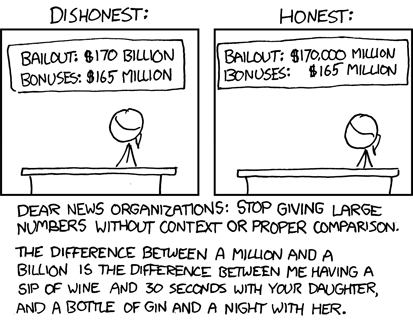
Signs of the Apocalypse, pt. 1

http://xkcd.com


So I've been holding this notion that everything in this blog should be thoroughly considered, if not researched, before I post it. This is likely the result of 4 years of writing under pretty strict academic standards, and it's exhausting. It also keeps me from writing. So I'm giving that up in favor of knee-jerk reactions and sometimes amateurish opinions - it's actually much more fun. 

Anyway, in the past couple of days I've come across some interesting perspectives on the whole AIG thing. The first, copied above, is an XKCD comic. (Side note - this comic is awesome). The second is a resignation letter published in the Times Opinion column today. I don't think I have much to add to it, but it would be cool to have a discussion in the comments section if you have any thoughts. 


Dear A.I.G., I Quit!
The following is a letter sent on Tuesday by Jake DeSantis, an executive vice president of the American International Group’s financial products unit, to Edward M. Liddy, the chief executive of A.I.G.

DEAR Mr. Liddy,

It is with deep regret that I submit my notice of resignation from A.I.G. Financial Products. I hope you take the time to read this entire letter. Before describing the details of my decision, I want to offer some context:

I am proud of everything I have done for the commodity and equity divisions of A.I.G.-F.P. I was in no way involved in — or responsible for — the credit default swap transactions that have hamstrung A.I.G. Nor were more than a handful of the 400 current employees of A.I.G.-F.P. Most of those responsible have left the company and have conspicuously escaped the public outrage.

After 12 months of hard work dismantling the company — during which A.I.G. reassured us many times we would be rewarded in March 2009 — we in the financial products unit have been betrayed by A.I.G. and are being unfairly persecuted by elected officials. In response to this, I will now leave the company and donate my entire post-tax retention payment to those suffering from the global economic downturn. My intent is to keep none of the money myself.

I take this action after 11 years of dedicated, honorable service to A.I.G. I can no longer effectively perform my duties in this dysfunctional environment, nor am I being paid to do so. Like you, I was asked to work for an annual salary of $1, and I agreed out of a sense of duty to the company and to the public officials who have come to its aid. Having now been let down by both, I can no longer justify spending 10, 12, 14 hours a day away from my family for the benefit of those who have let me down.

You and I have never met or spoken to each other, so I’d like to tell you about myself. I was raised by schoolteachers working multiple jobs in a world of closing steel mills. My hard work earned me acceptance to M.I.T., and the institute’s generous financial aid enabled me to attend. I had fulfilled my American dream.

I started at this company in 1998 as an equity trader, became the head of equity and commodity trading and, a couple of years before A.I.G.’s meltdown last September, was named the head of business development for commodities. Over this period the equity and commodity units were consistently profitable — in most years generating net profits of well over $100 million. Most recently, during the dismantling of A.I.G.-F.P., I was an integral player in the pending sale of its well-regarded commodity index business to UBS. As you know, business unit sales like this are crucial to A.I.G.’s effort to repay the American taxpayer.

The profitability of the businesses with which I was associated clearly supported my compensation. I never received any pay resulting from the credit default swaps that are now losing so much money. I did, however, like many others here, lose a significant portion of my life savings in the form of deferred compensation invested in the capital of A.I.G.-F.P. because of those losses. In this way I have personally suffered from this controversial activity — directly as well as indirectly with the rest of the taxpayers.

I have the utmost respect for the civic duty that you are now performing at A.I.G. You are as blameless for these credit default swap losses as I am. You answered your country’s call and you are taking a tremendous beating for it.

But you also are aware that most of the employees of your financial products unit had nothing to do with the large losses. And I am disappointed and frustrated over your lack of support for us. I and many others in the unit feel betrayed that you failed to stand up for us in the face of untrue and unfair accusations from certain members of Congress last Wednesday and from the press over our retention payments, and that you didn’t defend us against the baseless and reckless comments made by the attorneys general of New York and Connecticut.

My guess is that in October, when you learned of these retention contracts, you realized that the employees of the financial products unit needed some incentive to stay and that the contracts, being both ethical and useful, should be left to stand. That’s probably why A.I.G. management assured us on three occasions during that month that the company would “live up to its commitment” to honor the contract guarantees.

That may be why you decided to accelerate by three months more than a quarter of the amounts due under the contracts. That action signified to us your support, and was hardly something that one would do if he truly found the contracts “distasteful.”

That may also be why you authorized the balance of the payments on March 13.

At no time during the past six months that you have been leading A.I.G. did you ask us to revise, renegotiate or break these contracts — until several hours before your appearance last week before Congress.

I think your initial decision to honor the contracts was both ethical and financially astute, but it seems to have been politically unwise. It’s now apparent that you either misunderstood the agreements that you had made — tacit or otherwise — with the Federal Reserve, the Treasury, various members of Congress and Attorney General Andrew Cuomo of New York, or were not strong enough to withstand the shifting political winds.

You’ve now asked the current employees of A.I.G.-F.P. to repay these earnings. As you can imagine, there has been a tremendous amount of serious thought and heated discussion about how we should respond to this breach of trust.

As most of us have done nothing wrong, guilt is not a motivation to surrender our earnings. We have worked 12 long months under these contracts and now deserve to be paid as promised. None of us should be cheated of our payments any more than a plumber should be cheated after he has fixed the pipes but a careless electrician causes a fire that burns down the house.

Many of the employees have, in the past six months, turned down job offers from more stable employers, based on A.I.G.’s assurances that the contracts would be honored. They are now angry about having been misled by A.I.G.’s promises and are not inclined to return the money as a favor to you.

The only real motivation that anyone at A.I.G.-F.P. now has is fear. Mr. Cuomo has threatened to “name and shame,” and his counterpart in Connecticut, Richard Blumenthal, has made similar threats — even though attorneys general are supposed to stand for due process, to conduct trials in courts and not the press.

So what am I to do? There’s no easy answer. I know that because of hard work I have benefited more than most during the economic boom and have saved enough that my family is unlikely to suffer devastating losses during the current bust. Some might argue that members of my profession have been overpaid, and I wouldn’t disagree.

That is why I have decided to donate 100 percent of the effective after-tax proceeds of my retention payment directly to organizations that are helping people who are suffering from the global downturn. This is not a tax-deduction gimmick; I simply believe that I at least deserve to dictate how my earnings are spent, and do not want to see them disappear back into the obscurity of A.I.G.’s or the federal government’s budget. Our earnings have caused such a distraction for so many from the more pressing issues our country faces, and I would like to see my share of it benefit those truly in need.

On March 16 I received a payment from A.I.G. amounting to $742,006.40, after taxes. In light of the uncertainty over the ultimate taxation and legal status of this payment, the actual amount I donate may be less — in fact, it may end up being far less if the recent House bill raising the tax on the retention payments to 90 percent stands. Once all the money is donated, you will immediately receive a list of all recipients.

This choice is right for me. I wish others at A.I.G.-F.P. luck finding peace with their difficult decision, and only hope their judgment is not clouded by fear.

Mr. Liddy, I wish you success in your commitment to return the money extended by the American government, and luck with the continued unwinding of the company’s diverse businesses — especially those remaining credit default swaps. I’ll continue over the short term to help make sure no balls are dropped, but after what’s happened this past week I can’t remain much longer — there is too much bad blood. I’m not sure how you will greet my resignation, but at least Attorney General Blumenthal should be relieved that I’ll leave under my own power and will not need to be “shoved out the door.”

Sincerely,

Jake DeSantis

Tuesday, March 24, 2009

Parting Words

Oh hey there. Yes I'm attempting to resurrect this blog. Seems so typical even I'm already dis-enthused. So I won't squander the 10 seconds of your attention I have with an explanation for why there's a new post here after an absence of many months. I'll just consider the earlier posts a false start, and see where it goes from here. 

Naturally (and by that I mean ironically), the gravity that has pulled me back to this blog has inspired me to start with not my own thoughts, but those of a much wiser man I know. There's a professor at Dartmouth, Paul Christesen (Classics), who leads a weekly discussion group (called Discussion Group, of all things, or DG), of students to talk about, in a nutshell, our personal philosophies about life. He was inspired to start the group when, a few years back, he asked a graduating student what she was going to do (for a job). She said she was going to work in finance. He asked her why, and wouldn't you know it, she didn't have an answer. Even something like "It pays really well, and money is important because of x, y, or z," would have been better than having no answer at all. It struck Prof Christesen (probably not for the first time, as he is a Dartmouth alum himself), that there is a reprehensible lack of reflection at Dartmouth, and as a prof, he could do something to affect the situation. Voila DG. 

Usually the format for DG goes something like this: During the week, Prof Christesen (PCC) will blitz out an article or chapter of a book with some questions for us to consider. Then on Sunday, we get together and discuss. Also, throughout the year, DG members (there are about 8 of us) do something called a discourse, in which we'll talk about some questions we have about ourselves for about 20 minutes, and then answer questions from other people in the group. The whole thing takes about an hour and is absolutely exhausting, but also extraordinarily helpful. This winter though, part by chance and part by design, everyone in the group was a senior. So we did senior discourses, and at the end (because he's going to be in Greece in the spring), PCC gave his own discourse, which was more like a benediction. His advice - well, some if it - is what I want to share with you now. It consisted of about 5 cautionary tales and 5 reasons to be optimistic - I'll share bits of both. 

I should note quickly that I give what PCC says an enormous amount of credibility because besides being extraordinarily contemplative himself, he's exceptionally popular among his former students, and they visit him frequently. Through them he's developed what I consider to be some remarkably valid theories about life. Here are a few. 

Money, PCC tells us, is valuable for one very important reason. Anybody who says it's not is either crazy or deluding himself. But the only reason that it's important is to buy us the freedom to live the lives we'd like to live. Perhaps this seems obvious. I want to travel, so I need money. I want my kids to not worry about paying for college, so I need money. But somewhere along the way, money ceases to be a means to an end, and instead becomes an end in itself, and we give up the freedom we were seeking in order to make money. Again, this seems obvious on the surface, but an extraordinarily high number of people seem to fall into this trap. And thus its simplicity is what makes this advice so poignant - if we remember that money is important only to give us our freedom, then we should never find ourselves slaves to our money. 

The next bit was, I thought, the most provocative. PCC told us that a former student of his - one who is very successful in his profession - once told him that, "I wish I had known 5 years ago when I started this job that I'd become the kind of person that is successful at it." Dartmouth students (and anyone reading this blog, I'm sure) are really good at figuring out how to be successful in whatever environment they're in, PCC told us. In other words, as if by instinct, we do whatever is necessary to advance in our professions, even if it means becoming someone we did not want to be. Naturally, this happens without actually realizing it, or else it would not happen. So when you're thinking of taking a job, consider the people who have advanced in that job. Do you like them? Do you want to be like they are? Because if you stay in that job, you will become one of them. That's kind of scary. 

But now for some good news! 

"Your best years are ahead of you." Wow! Not a lot to say about this one I guess. It's hard to offer proof. But if you trust PCC like I do, it's nice to hear. 

A unified theory of everything: 
PCC does a lot of thinking. He's a classicist, and so he's got sort of a weird reductionist way of going about it that I don't really understand. But he said he realized while going for a walk one night that all of the advice he gives is, at heart, about being with people you like. In short, if you like the people in your life, you will be happy. If you don't, you won't. It seems to simple to be true. But then, I think we tend to overcomplicate things. 

Your thoughts? 

Thursday, June 12, 2008

Notes on the last post

Just a thought: I feel some people may think that I come across as a little self-righteous in the last post. As far as my thoughts on proclaimed liberals who use cocaine go, I submit that that's impossible. However, one could argue that I am a hypocrite just by my very existence as a citizen of and consumer in the United States. This is not entirely unfair as I'm sure all of us are indirectly responsible for some, if not many, deaths simply because we live in this country. The most important part of Blood Diamond is, I think, when Leonardo DiCaprio's character tells Jennifer Connelly's that despite her motives and intentions, she is also complicit in the violence simply because she writes for a magazine in which the diamond industry advertises. One of the goals of this blog is to figure out how we can avoid such traps (as well as hopefully discover other hypocrisies or inconsistencies I'm guilty of). But while the connection between buying a ring and someone's death is usually difficult to make or understand, the connection between using cocaine and the terror that has gripped Mexico is not.

Monday, June 9, 2008

Hypocrisy and the Real World

If you really want to insult my character, call me a hypocrite. It is, I believe, one of the worst charges that can be levied against someone. And I'm not taking about the "Do as I say, not as I do" variety of hypocrisy. Though lighting up a cigarette while telling someone smoking is bad is in fact stupid, there's something approaching noble about being able to publicly acknowledge your own faults while trying to prevent others from copying them.

Needing to find focus for this post, I turned to Merriam-Webster for some help. I was surprised to find that these gents provided me with not one but two definitions for hypocrite. One is what I think is usually invoked by the term: "a person who acts in contradiction to his or her stated beliefs or feelings." The other is, I believe, much worse: "a person who puts on a false appearance of virtue or religion." For the sake of this post, I consider this definition an extension of the first. Both involve actions that contradict a professed idea, (how else could the 'appearance' be 'false') but the second distinguishes from a "belief" - which could be as trifling as some old proverb someone is fond of repeating - and "virtue or religion": a way of life, or an entire system of beliefs. The first definition is fleeting and limited: a person is a hypocrite about something; whereas the second is a permanent indictment: a person is a hypocrite.

So where am I going with this? Actually, it's taken me three days to figure it out. I think I'm going to talk about two examples of hypocrisy: the first will be uncharacteristically specific; the second will be of the usual general persuasion.

Something that's bothered me a lot lately (it came up again recently in a conversation with a friend) is the pervasive abuse of cocaine at Dartmouth and likely many other residential learning institutions (last month's massive drug raid at San Diego State University, anyone?) Here's the thing: thousands of murders each year are directly related to the trafficking of cocaine from South and Central America to the United States. An entire town in Mexico has been turned into a literal war zone and been held hostage by trafficking-related violence in recent months. All of this means that depending on their location and the length of their supply chain, cocaine users are inevitably and invariably separated no more than a few degrees from someone's murder. That's not to mention their complicity in contributing to the fear that has gripped many of Mexico's innocents, like those in Villa Ahumada, a small town just 85 miles south of the US border.

Cocaine users are more than just associates to murder. The fact that many of them consider themselves politically and socially liberal makes them hypocrites. They'll rail for universal health care and an end to the war in Iraq (presumably because innocent people are needlessly dying), but not give a damn that their habit is turning Mexico into 1980's Colombia. This contradiction shows their projected liberal persona to be nothing but a "false appearance of virtue or religion." They are selfish and weak, and their overwhelming feelings of entitlement and complacency with their own hypocrisy are frankly sickening. I am increasingly saddened and frustrated that I share an alma mater with many of them. I would honestly rather someone profess to not give a damn about people and have a coke habit than claim - often with ostentatious gestures - to care, then turn around and put the figurative ashes of a Mexican law enforcement officer up his nose.

Part II of this post tomorrow.

An aside

After being up at Dartmouth this past weekend for Commencement I find it appropriate to thank my French host mom from last winter, Miki, for giving me a copy of Le Petit Prince. It's always a help in times like these: J'y gagne, dit le renard, à cause de la couleur du blé.

The Little Prince, by the way, may just be the most appropriate book for this blog. If it were any way possible, I would make it required reading for the entire world.

Thursday, May 29, 2008

Happiness I

Just a question - is it possible that something can make us happier while we're using/experiencing it, but not happier overall? For instance, if I were to buy a new Mac because it's great for photo editing (and I like photo editing... or really, digital art), I'm sure I would be very happy using it. But would it actually contribute to my overall happiness? The kind of happiness that you get asked about in a survey: "On a scale of 1 to 10, how happy do you think you are?" If it doesn't contribute to that kind of happiness, but the amount of time I spent at work to be able to afford the computer made me unhappy in a more permanent sense, then don't I experience a net loss on the deal?

Is this simply a spending money wisely issue put another way? Or am I right in feeling that there's more to it than that?

If there is, what kinds of things do make us 'permanently' happy? For me, I think that an ideal life (at least for a few years) would be working in a hostel in Europe, making just enough money to travel a little and drink wine and read books. Do the acts of drinking wine and reading books give me that permanent kind of happiness, or are they just, in the end, like the Mac? Or have I associated them with a type of lifestyle, one that I think will make me happy? What kind of lifestyle is associated with the Mac?

The next questions are maybe hugely ambitious, but I'll throw them out here and maybe come back to them again later:
What does a family of 4 with an income of $40,000 do to achieve happiness?
What does a family of 4 with an income of $400,000 do to achieve happiness?
Or, you could think of it in terms of single people if that's easier. Say $20,000 vs. $200k.

There are a quite a few people who have visited without commenting. Maybe I'm boring you to death, and that's fine. But if this is interesting to you at all, please, let us know what you're thinking!

Tuesday, May 27, 2008

Progress and the Pursuit

It's become cliché to talk about the increasingly fast-paced nature of contemporary society, especially American society. But since we won't understand the implications of the new globalization period we're in combined with the advent of instant global communications and ubiquitous interconnectivity, that fact shouldn't stop us from having a conversation about, well, the whole point of our society's existence. [Insert another cliché about how to eat an elephant here.]

In all seriousness though, I think this question - what is the ultimate goal of our civilization - is a dangerously neglected one. Sure, people wonder all the time about the "meaning of life," or, put another way, "Why am I here?" but these questions focus only on the individual's existence. Thus, these considerations are inherently limiting. Focusing solely on them prevents or distracts us from considering or questioning many of the things we take for granted.

One of those things is, I think, the idea of "progress." America as a whole seems obsessed with it. The old DuPont slogan, "Better living through chemistry" comes to mind. We are a society transfixed with new conveniences and new discoveries that somehow make our lives better. I should make the distinction that I'm not talking about political or social progressivism, specifically equal-rights issues, but mostly inventions and scientific breakthroughs that are designed to increase the quality of our lives. A new golf club that helps us drive the ball further; automatic windshield wipers - I don't know what we'd do without them; detergent with 33% more scrubbing action; "Books are too difficult to carry around - maybe they'll invent something that fits in my pocket and can digitally store every book I have..." But perhaps my point is best illustrated by showing an opposite example.

Last summer, a group of traveling Buddhist monks visited Dartmouth for a one week residency. One night, they gave a presentation in our big auditorium, demonstrating how they traditionally carry out debates in their temples. Compared to the Americans in the audience, a casual observer knowing little about Buddhist culture might have called the monks relatively primitive. Indeed, their dress and dwellings are much simpler than ours. Their scientific knowledge is not as advanced. Certainly, their per-capita income, even adjusted for purchasing power parity, does not come close to that of Americans. And yet I have to say that their society is infinitely more advanced than ours. Without professing to know much about Buddhism, it's more or less true that they, as a culture, have reached the goal of their collective existence. All they really have left to accomplish is to, as individuals, find enlightenment through meditation and debate. Our society, meanwhile, hires hundreds of college grads each year just to figure out new ways to turn money into more money, without actually producing anything and with the money itself existing only as an idea - a bit of code in some computer somewhere. Meanwhile, we continue to obsess about the newest products to hit the market.

When will progress take us to where we want to be? If this question is impossible to answer, it is because rather than treating progress as a means to an end, we treat it as an end itself. It seems that rather than figuring out ways to progress toward a societal goal, we only work on achieving progress itself.

By all accounts, our Declaration of Independence is a brilliant and powerful document. But when Jefferson adapted John Locke's "life, liberty, and estate [or possessions]" to "...life, liberty, and the pursuit of happiness," he helped cement an American mindset - that of the pursuit - that has grown steadily from our foundation to the pervasive monstrosity that it has become today. And in this pursuit of ours, for the things that we believe will help us achieve happiness, we seem to have forgotten what happiness actually is. Is it a coincidence that as America has become richer, our most commonly prescribed medications are for stress and depression-related illnesses? As the psychologist and social scientist Peter Whybrow says, "Americans are not as happy as they are rich." More on Whybrow later.

What I've written so far troubles me a little bit because its implications border on anti-intellectualism, and I am no anti-intellectual. And one can say that the Dark Ages were defined by a suffocating lack of progress, so am I arguing for a return to 11th Century Europe? These are some of the questions that, with your help, I hope to figure out. But it's worth considering - while a pocket machine that can hold all your books is empirically more useful, or, we might say, just better - than a library full of physical prints, does having it actually make us happier? And what are its costs?

But this argument is really just the beginning to many others. One of these focuses on the morality of science (indeed, the point of science, and another explores the reason that despite their growing wealth, Americans are becoming increasingly unhappy.

Your thoughts?

Sunday, May 25, 2008

A new beginning

A couple of years ago, I started a blog as a device to provide some sort of consistency to my journal writing. I figured that if I were writing for an (admittedly small) audience, I would have a greater incentive to write regularly. The experiment had mixed results: 38 posts in the first 2 months led to only 29 more after as I gradually but steadily lost inspiration and willpower (and, thus, inevitably, the audience).

This blog is going to be mostly similar to the last, but without any of the "Dear Diary, this is what I did today" type posts. And there are a few main reasons I'm reentering the blogosphere. The first is I believe that the two most important things in our world - romance and art (indeed, perhaps they are the same) - are under assault. The others are a bit less easy to summarize in a sentence. One has to do with the prevailing perceptions of my generation (variously called Generation Y, the MySpace/i/Google/New silent/Connected Generation, and, my favorite, Generation whY). I reject that we're as lazy, ignorant, and selfish as we are often characterized. One study, for example, finds that people of my generation are consistently rejecting leadership roles. But where many see apathy, I see disillusionment. The fact of the matter is that we did not choose to inherit the world or, more specifically, country of which we are about to take control. I think that a lot of young people will, perhaps with some prodding, assert that they are extremely frustrated with the established system and power, but they see little avenue for actual change. But maybe not. Maybe we students need a real shot in the arm to actually realize what potential we have. And I admit that just talking about it, as in this blog, may not accomplish much.

This brings me to the actual theory, if I may call it that without seeming revoltingly arrogant, of this blog. It's simply a test - a forum for discussion. An internet agora. Because in my three years at Dartmouth, I've learned more in a couple of discussion groups I participate in than in all my classes and most of my other extracurriculars combined. Not in absolute terms, of course. After all, the social science major taught me a completely new way to think. But the most important things.

One of the best and most profound pieces of advice ever given me was by this guy Jeff, the owner of a café and bar I frequented in Toulouse last year. We got pretty close, and when I headed out the door on my last night in the city, he shook my hand, looked me in the eye, and said "Enjoy your life." This statement can be taken simply, or it can grow to an enormous complexity. I take the latter view. Just defining "enjoyment" is, I think, a colossal undertaking, and then we have to figure out how to actually achieve it. This task will be another theme of the blog.

If everything I've written so far seems kind of nebulous, it is simply because I don't actually have a real solid idea of what I want to do here. But, in the least, everything above should form some of the threads that are strung through the posts in the months to come. We'll see how it goes. Thanks for reading.